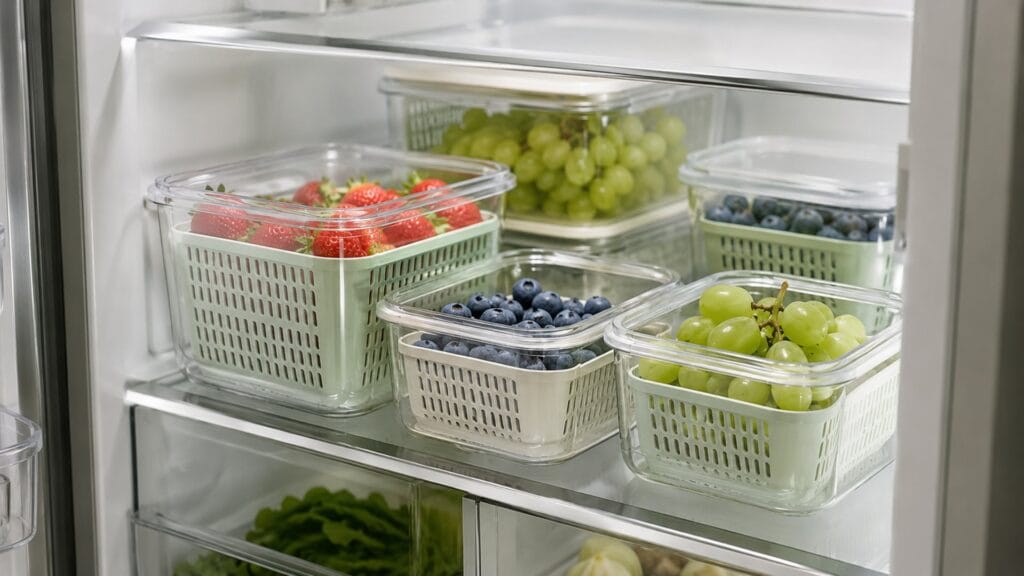
If you keep pulling moldy berries or wilted greens out of your fridge before you even get to use them, the problem usually isn’t the produce — it’s trapped moisture. Fruit storage containers with colander inserts are built to solve exactly that by lifting produce above the water that would otherwise sit and speed up spoilage. This guide covers how fruit storage containers with colander inserts actually work, who they help most, and one real option worth considering.
Quick Answer
Fruit storage containers with a removable colander work by separating produce from condensation and rinse water, which slows the mold growth that shortens shelf life. They’re most useful for berries, grapes, and other high-moisture produce you buy in bulk. Our featured pick below is an 8-piece polypropylene set with four size tiers, a silicone-sealed lid, and a removable colander insert — check current price on Amazon.
How Fruit Storage Containers With Colander Inserts Actually Work
Produce doesn’t stop “breathing” after it’s picked — it keeps releasing moisture through respiration, and that moisture has to go somewhere. In a sealed container without drainage, it pools around the fruit and creates the damp environment mold needs to take hold. Michigan State University Extension notes that different produce needs different humidity levels, and that airflow control is one of the main levers for extending shelf life (source).
A colander insert addresses this directly: the produce sits in a perforated basket raised above the container floor, so condensation and rinse water drain down and away instead of sitting against the fruit. It’s a simple mechanical fix, not a chemical or technological one — which is also why it’s realistic to expect a fruit storage container with colander to help, without expecting it to work miracles on produce that was already going soft when you bought it.
Who Actually Needs One of These?
- You buy berries or grapes in bulk and regularly lose a chunk of the container to mold before you finish it
- You meal prep with cut produce and want a cleaner system than loose produce bags in the crisper drawer
- You want to rinse and store in one step — the colander doubles as a washing basket
- Your crisper drawer is disorganized and produce gets lost or forgotten at the back
Who Can Skip This
If you buy produce in small quantities and use it within a day or two, a colander container probably won’t change much — the moisture problem mainly shows up over longer storage windows. And if you need one very large container for something like a whole melon, the largest size in most of these sets (usually under 3 quarts) may still be too small.
What to Look for in a Fruit Storage Container With Colander
- Multiple size tiers — berries and leafy greens need different container sizes; a single-size set is less flexible
- Removable colander — fixed, non-removable baskets are harder to clean thoroughly
- Sealed lid with a locking mechanism — clip-on locks with a silicone ring hold humidity better than a simple snap lid
- BPA-free, food-grade material — look for polypropylene (PP-5) specifically, which tolerates both freezing and hot dishwasher cycles
- Stackability — matters more than it sounds like once you have 6-8 containers competing for crisper drawer space
Our Pick: 8-Piece Fruit & Produce Storage Set With Removable Colander
This is a straightforward, no-frills fruit storage container with colander set that checks the boxes above. It’s sold under a generic/unbranded listing (manufacturer listed simply as “LY”), so there’s no established brand reputation behind it — worth knowing going in, though the published specs are solid.
✅ Pros
- Four size tiers cover berries through bulk salad greens
- Removable colander keeps produce separated from pooled moisture
- Freezer safe, and dishwasher/microwave safe once the lid is off
- Wide temperature tolerance for a polypropylene container
- Compact stacking footprint fits a standard crisper drawer
❌ Cons
- Unbranded/generic listing — no long-standing brand or warranty reputation
- Lid must be removed before dishwasher or microwave use, which is easy to forget
- The smallest 0.34 qt size is really only useful for garnish-size portions
- One more part (the colander) to wash per container
| Spec | Details |
|---|---|
| Pieces | 8 total — 2 each of 4 sizes |
| Sizes | 0.34 qt, 0.87 qt, 1.7 qt, 2.85 qt |
| Total capacity | 11.7 liters combined |
| Material | Polypropylene (PP-5), BPA-free, food grade |
| Temperature range | -22°F to 284°F (-30°C to 140°C) |
| Dishwasher / microwave | Safe with lid removed |
| Freezer safe | Yes, with lid on |
| Seal | Silicone ring + 4-point clip-on lock |
| Colander | Removable, raised 4-leg design |
| ASIN | B0GX9QPSXY |
| Price | See current price on Amazon |
3 Storage Mistakes That Waste Produce Even With a Colander Container
A fruit storage container with colander helps with drainage, but it can’t fix these common habits:
- Washing berries before storing them. Extension guidance consistently recommends washing produce right before you eat it, not before storage — pre-wash moisture speeds up mold even with a colander draining it away.
- Mixing ethylene-sensitive produce with ethylene producers. Apples and bananas release ethylene gas that speeds up ripening in nearby berries and greens. Keeping them in separate containers matters as much as the colander does.
- Overpacking the container. Cramming produce in tight reduces the airflow the colander design depends on. A half-full container with room to breathe often outlasts an overstuffed one.
Cleaning & Maintenance
Since the colander insert is removable, hand-wash it separately from the base when produce residue builds up — the small drainage holes trap pulp more than the smooth container walls do. If the set is dishwasher safe, run the base and colander without the lid, then check the silicone seal ring periodically; a dried-out or warped seal is usually why a previously airtight fruit storage container with colander starts fogging up again.
Frequently Asked Questions
Do fruit storage containers with colander inserts actually work?
Yes, for the specific problem they’re built to solve. Raising produce above pooled condensation and rinse water genuinely slows mold growth, per general food-storage guidance from extension services. They won’t rescue produce that’s already going soft when you buy it.
Can I put these in the freezer?
For our featured pick, yes — the manufacturer lists it as freezer safe with the lid on. Always check the individual product’s listing, since freezer safety varies by material and design.
How do I clean the colander insert?
Hand-wash it separately from the base — the drainage holes trap pulp more than smooth container walls do. If dishwasher safe, run the base and colander with the lid removed.
Should I wash berries before storing them in a colander container?
No. Wash produce right before eating it, not before storage. Pre-wash moisture speeds up mold even in a container designed to drain it away.
Bottom Line
The core idea behind a fruit storage container with colander is sound and backed by basic food-storage science — moisture control genuinely extends shelf life. Whether a specific set is worth it comes down to how much bulk produce you actually buy and how much you’re currently losing to spoilage. For most households that go through berries or bagged greens regularly, a multi-size fruit storage container with colander like the one above is a low-cost way to test whether it makes a real difference in your kitchen.
Related reading: our complete guide to fridge storage times and glass vs. plastic meal prep containers comparison.