By Mustafa•Reviewed against USDA Food Safety Guidance•Updated July 2026•8 min read
Disclosure: Isrova has applied to the Amazon Associates Program and is currently awaiting approval. No commission is currently earned from any link on this page. This will never influence our recommendations.
Quick Answer
How long does meal prep last in the fridge? Most cooked meal prep lasts 3 to 4 days. Cooked chicken and fish: 3 to 4 days. Cooked beef and pork: 3 to 4 days. Cooked grains: 4 to 6 days. Roasted vegetables: 3 to 4 days. Raw chopped vegetables: 3 to 5 days (hardier vegetables like carrots and celery can last longer). These timelines assume an airtight container and a fridge temperature at or below 40°F.
Key Takeaways
Most cooked meal prep lasts 3–4 days in the fridge.
Freeze anything you won’t eat within 4 days.
Keep your fridge at or below 40°F (4°C).
A properly sealed airtight container helps food stay fresher — but doesn’t extend the safe-storage limits below.
Throw away food with off smell, sliminess, or visible mold — don’t taste-test.
How long does meal prep last in the fridge? It’s the question that determines whether meal prep actually works for you. The moment you open a container and wonder if the chicken is still good, the habit breaks down. You throw it out, order delivery, and skip prep the following week.
This guide gives exact shelf life timelines for every common meal prep food — based on USDA food safety guidelines, not guesswork. It also covers the signs that food has turned, and when freezing makes more sense than refrigerating.
Important: These timelines assume food was cooked to safe internal temperatures, cooled within 2 hours of cooking, and stored in airtight containers at 40°F or below. Food stored at higher temperatures spoils faster. When in doubt, throw it out.
How Long Does Meal Prep Last: Complete Shelf Life Guide
Food Type
Fridge (40°F)
Freezer (0°F)
Safety Status
Cooked chicken breast
3–4 days
2–6 months
Safe
Cooked ground beef
3–4 days
2–3 months
Safe
Cooked salmon / fish
3 days max
2–3 months
Use Fast
Hard-boiled eggs
1 week
Not recommended
Safe
Cooked rice
4–6 days
1–2 months
Safe
Cooked quinoa
4–6 days
1–2 months
Safe
Cooked pasta
3–5 days
1–2 months
Safe
Roasted vegetables
3–4 days
10–12 months
Safe
Raw chopped vegetables
3–5 days
8–12 months
Safe
Cooked beans / lentils
3–4 days
1–2 months
Safe
Soups and stews
3–4 days
2–3 months
Safe
Salad greens (undressed)
3–5 days
Not recommended
Use Fast
Cut fruit
3–5 days
10–12 months
Check Daily
Overnight oats
5 days
Not recommended
Safe
Homemade dressings (oil & vinegar)
1–2 weeks
Not recommended
Check for separation
Homemade dressings (dairy / mayo-based)
3–5 days
Not recommended
Use Fast
Shelf Life by Food Category
🍗 Cooked Proteins
3–4 days
Chicken, beef, pork, turkey. Fish is shorter — use within 3 days. Store in airtight containers immediately after cooling.
🌾 Cooked Grains
4–6 days
Rice, quinoa, farro, barley. Cool completely before sealing — steam inside the container accelerates spoilage.
🥦 Cooked Vegetables
3–4 days
Roasted or steamed vegetables. Leafy greens cooked down last only 2 to 3 days — use those first.
🥗 Raw Vegetables
3–5 days
Chopped peppers, cucumber, and most vegetables: 3 to 5 days. Hardier ones like carrots, celery, and radishes can last 5 to 7 days, especially stored submerged in water. Keep dry and store with a paper towel to absorb moisture.
🥚 Eggs
1 week
Hard-boiled (unpeeled): 1 week. Peeled hard-boiled: best used within 5 days. Scrambled or fried eggs: 3 to 4 days.
🍲 Soups and Stews
3–4 days
Leave 1 inch of headspace in container — liquid expands when cooling. Cool to room temperature before sealing and refrigerating.
Signs Your Meal Prep Has Gone Bad
Day count is a guideline. Actual spoilage depends on fridge temperature, how quickly food was cooled, and container seal quality. Check these signs before eating anything close to its limit.
👃
Off Smell
Any sour, rancid, or unusual odor means discard. Trust your nose — it detects bacterial growth before other signs appear.
🎨
Color Change
Gray chicken, brown edges on cut vegetables, or any unexpected color shift means the food is past safe use.
💧
Slimy Texture
Sliminess on cooked chicken or vegetables is bacterial film. Do not rinse and eat — discard immediately.
🟢
Visible Mold
Any visible mold means discard the entire container — not just the moldy section. Mold spreads through food before it is visible.
🫧
Bubbling
Bubbles in sauces, soups, or grains indicate active fermentation. Safe fermented foods are intentional — anything else gets discarded.
💨
Pressurized Lid
A lid that pops or bulges when opened means gas buildup from bacterial activity. Discard without tasting.
When to Freeze Instead of Refrigerate
Prepping more than 4 days ahead means freezing is safer than refrigerating. Frozen meal prep extends your range from 4 days to 3 months without food safety risk.
Cooked chicken
2–6 months
Freeze in portions. Thaw overnight in fridge.
Soups and stews
2–3 months
Leave 1 inch headspace for expansion.
Cooked rice and grains
1–2 months
Spread flat to freeze, then stack.
Roasted vegetables
10–12 months
Texture softens slightly after freezing.
Cooked beans
1–2 months
Freeze in cooking liquid to prevent drying.
Overnight oats
3 months
Thaw overnight. Stir before eating.
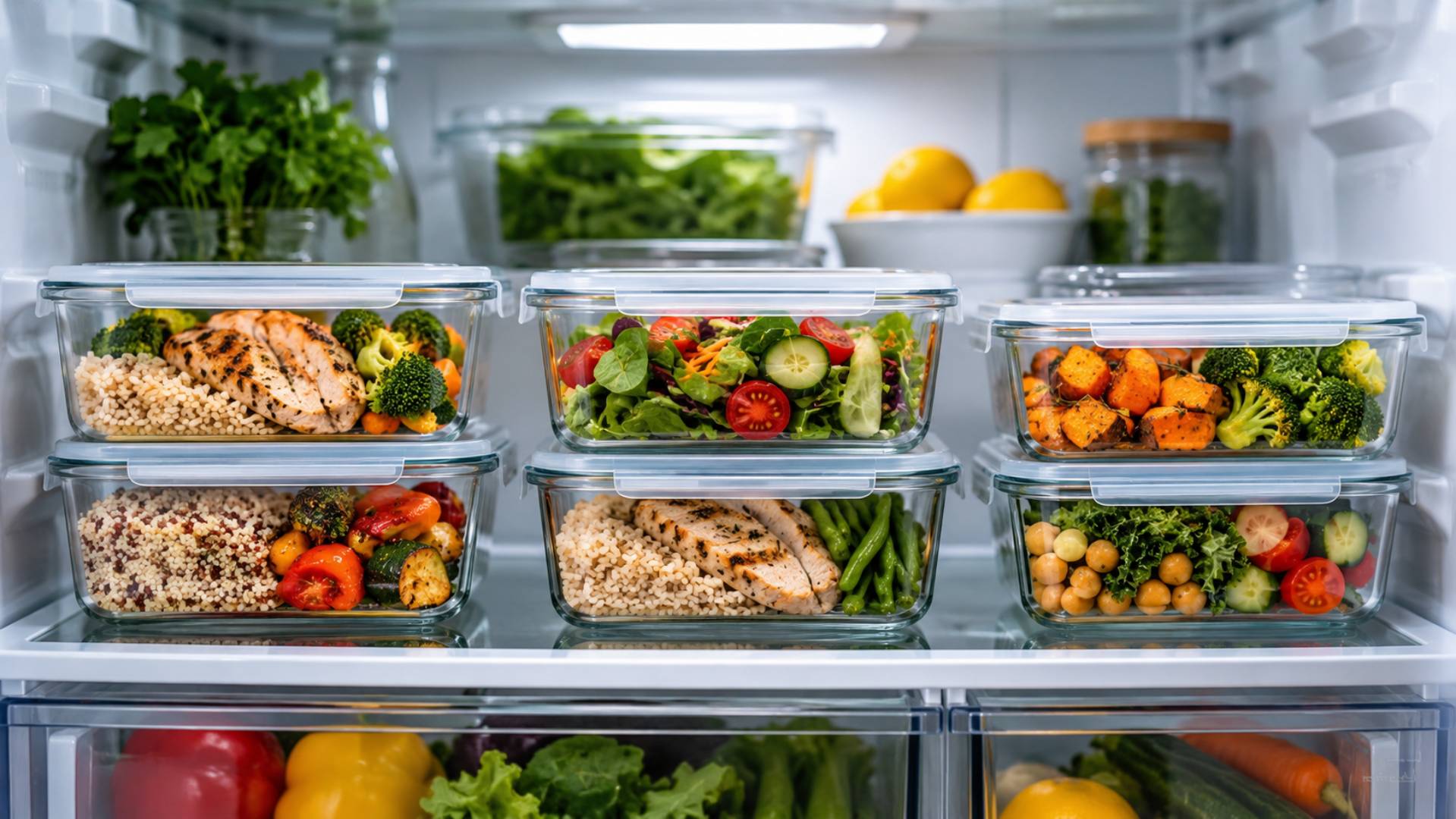
Container tip: The container you use affects food safety and quality. A properly sealed airtight container slows oxidation and moisture loss, which helps food stay fresher within the storage windows above — but it doesn’t extend those limits. Glass containers with 4-sided snap-lock lids hold a seal better than loose-fitting lids over repeated use. See our guide to leak-proof meal prep containers for specific picks.
The 2-Hour Cooling Rule
Cooked food left at room temperature for more than 2 hours enters the bacterial danger zone — 40°F to 140°F — where bacteria double every 20 minutes. Food prepped and left on the counter while you “let it cool” for 3 hours before refrigerating is already compromised, regardless of how it looks or smells.
Cool food faster by spreading it in shallow containers rather than storing in deep pots. Divide large batches into smaller portions immediately after cooking. Refrigerate within 2 hours — within 1 hour if the room is above 90°F.
Prep 4 days at a time — Sunday through Wednesday — and you stay within safe limits for every food on this list. Proteins last 3 to 4 days. Grains last 4 to 6. Most raw vegetables last up to 5, with a few hardier ones lasting longer.
For anything beyond 4 days, freeze it. Frozen meal prep is just as convenient — move portions to the fridge the night before you need them.
The container matters too, just not as much as the timeline above. A good seal helps food stay fresher for the full window — cling wrap or a partially closed lid won’t hold up as well as an airtight container over several days.
Most meal prep lasts 3 to 4 days in the fridge. Cooked proteins like chicken, beef, and pork: 3 to 4 days. Cooked grains: 4 to 6 days. Roasted vegetables: 3 to 4 days. Raw chopped vegetables: 3 to 5 days. These timelines assume airtight storage at 40°F or below.
For most proteins, 5 days pushes past the safe limit. Cooked chicken and fish should be eaten within 3 to 4 days. Cooked grains can safely reach day 5, but roasted vegetables should stay within 4 days. If you need 5-day coverage, freeze Sunday’s batch and pull it Thursday — that is safer than refrigerating for 5 full days.
Prep 4 days worth and freeze the rest. Prep Sunday for Monday through Thursday. Freeze portions for Friday and the following week. This keeps everything within safe fridge limits while still covering a full week of meals.
Trust your nose first — off smells appear before visible signs of spoilage. Check for slimy texture on proteins, color changes, visible mold, or a pressurized lid when opening. Any of these means discard without tasting. Do not rely on appearance alone — food can look fine while already unsafe.
Yes, indirectly. Airtight containers with proper gasket seals slow oxidation and moisture loss, which helps food stay fresher within the storage times above — they don’t extend those limits. Glass containers with 4-sided snap-lock lids maintain a tighter seal through repeated use than budget plastic.
Cooked chicken lasts 3 to 4 days in the fridge according to USDA guidelines. Store in an airtight container within 2 hours of cooking. Do not leave it at room temperature longer than that. If you need it to last beyond day 4, freeze it on the day it was cooked.