Buying Guide · Meal Prep Containers
Glass Meal Prep Containers for Weight Loss:
What Actually Matters Before You Buy
📅 Last reviewed: July 3, 2026
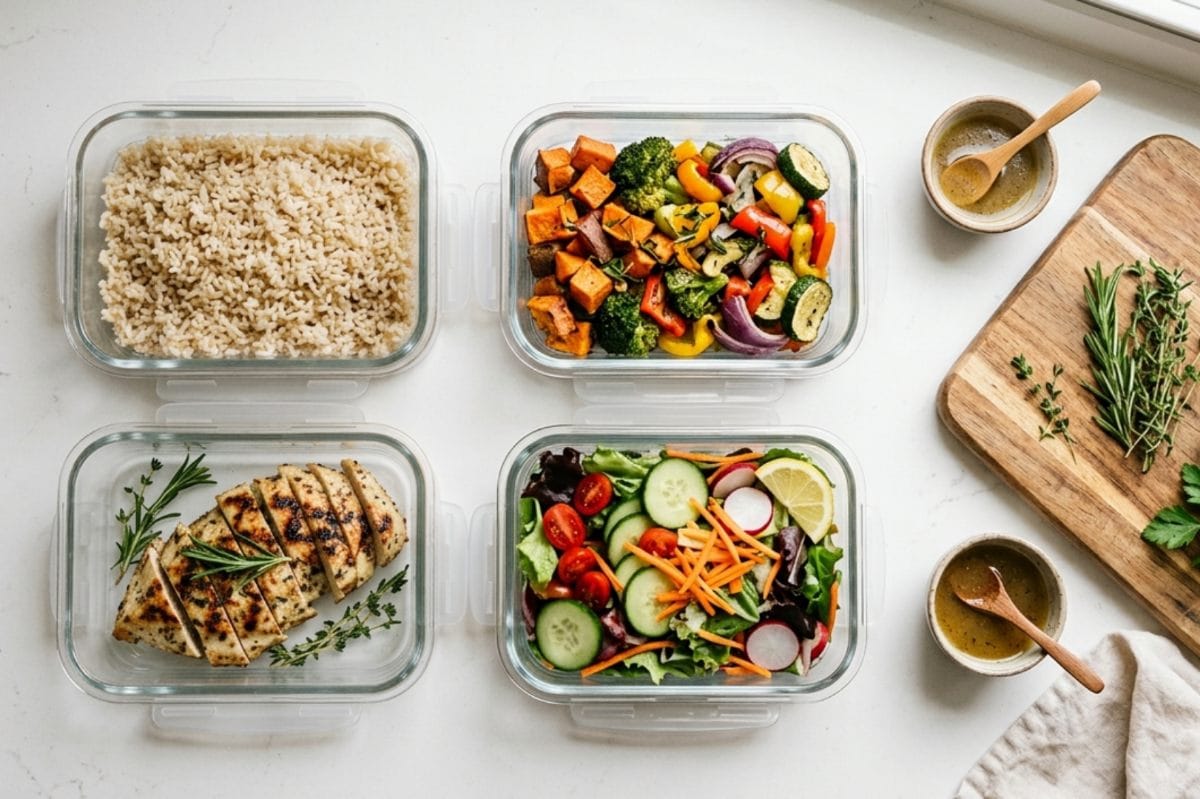
Glass meal prep containers work best for weight loss when you eat most meals at home or at a desk. For daily commuting, lightweight BPA-free plastic is more practical. Regardless of material, lid quality is the single most important feature to evaluate — not brand name, price, or aesthetics. The 750ml–1,000ml size range covers most calorie-controlled portion targets.
Why Glass Containers Support Weight Loss Habits
If you’re looking at glass meal prep containers for weight loss, you’ve probably already decided glass is the right material. You know it’s heavier and costs more upfront. The question you actually need answered is: which glass container is worth buying for this specific goal?
Let’s be direct. Glass doesn’t burn calories. A glass container filled with a poorly planned 900-calorie meal is no better than a plastic one. What glass containers do provide — when chosen correctly — is infrastructure that supports the habits that support weight loss:
- Portion consistency. Glass doesn’t warp or bow after repeated heat cycles the way plastic does. The container you use to measure your first meal behaves identically six months later.
- Visual clarity. Clear glass lets you see exactly what you packed before opening. For anyone tracking food visually or photographing meals for a log, this matters more than it sounds.
- Odour and stain neutrality. Polypropylene plastic absorbs flavours and stains from high-spice, high-fat foods over time — the exact foods that make many diet protocols more sustainable. Glass stays neutral indefinitely, which means the meal prep experience doesn’t gradually degrade.
- Oven compatibility. Borosilicate glass can go from refrigerator to oven, opening cooking methods unavailable with plastic containers.
Not sure yet whether glass is right for your routine? Our complete meal prep containers buying guide covers all material types side by side so you can decide before committing to a set.
The 6-Factor Evaluation Framework for Glass Meal Prep Containers
Most glass meal prep containers compete on price and aesthetics. Neither tells you whether the container will still be working reliably in month six. Here are the six factors that actually matter for weight loss meal prep — ranked by impact on your daily experience.
1. Lid Integrity
Four locking clips with a continuous silicone gasket is the reliable standard. Two-clip or press-fit lids are fine for dry meals only — they will leak liquids, dressings, and soups during transport.
Critical for transport2. Accurate Volume Labelling
For calorie tracking, stated capacity must be accurate. Some listings state volume to the rim; others to a practical fill line. Buyer reviews are the most reliable check for actual usable capacity vs. advertised number.
Critical for portion control3. Glass Type
Borosilicate glass handles thermal cycling — freezer to oven — better than soda-lime glass. If you plan to cook in your containers, glass type matters significantly. We cover this fully in Section 3.
Critical if oven use planned4. Stackability
Prepping five to seven days of meals at once makes refrigerator space a real constraint. Containers with flat-top lids stack cleanly. Lids with raised clips or handles on top typically don’t stack at all.
Important for batch prepping5. Carry Weight
A 3-cup glass container filled with food can weigh 1.5–2 lbs. Two containers (lunch and gym snack) adds 3–4 lbs of bag weight before anything else. If you commute on foot or transit, this adds up fast.
Important for daily carry6. Lid Replaceability
Lids fail before the glass does. The silicone gasket compresses; clips crack. If a brand doesn’t sell replacement lids separately, a failed lid means replacing the entire container — a hidden long-term cost.
Important for long-term valueThese criteria are consistent with the research approach used across all Isrova reviews. For a full explanation of how we evaluate products, see our editorial policy and review methodology.
Borosilicate vs. Soda-Lime Glass: What the Difference Means for You
Most container listings don’t clearly state which glass type they use — which makes this distinction both important to understand and frustrating to verify. Here’s what it means in practice.
Borosilicate Glass
Borosilicate glass contains boron trioxide, giving it a significantly lower coefficient of thermal expansion than standard glass. It handles thermal shock — sudden temperature changes like moving from a cold refrigerator directly into a preheated oven — far better than soda-lime glass. It’s the material used in laboratory glassware and quality bakeware.
Soda-Lime Glass
Soda-lime glass is the most common type found in consumer products. It’s perfectly adequate for the three scenarios most meal preppers use every day: refrigerator storage, microwave reheating, and dishwasher cleaning. Where it underperforms is direct oven use at high temperatures and rapid temperature transitions.
| Use Case | Borosilicate | Soda-Lime |
|---|---|---|
| Refrigerator storage | ✔ Safe | ✔ Safe |
| Microwave reheating (lid off) | ✔ Safe | ✔ Safe |
| Dishwasher (any rack) | ✔ Safe | ✔ Safe |
| Freezer storage | ✔ Safe | ✔ Safe (leave headroom) |
| Oven use (up to ~400°F) | ✔ Usually safe | ⚠ Risky — check specs |
| Freezer directly to oven | ⚠ Allow thaw first | ✘ High crack risk |
| Drop resistance | ⚠ Will break if dropped | ⚠ Will break if dropped |
How to Tell Which One You’re Buying
- Look for “borosilicate” explicitly in the product title or specifications table — not just in the description where the word is sometimes used loosely.
- Check if the product is oven-safe and at what temperature. Products rated for direct oven use at 400°F or above are typically borosilicate.
- Check buyer reviews for cracking reports, particularly from buyers who moved containers between cold and hot environments.
- Contact the manufacturer directly if oven use is a priority and the listing doesn’t specify.
Still deciding between glass and plastic entirely? Our dedicated glass vs. plastic meal prep containers comparison covers both materials in full detail, including long-term cost and environmental considerations.
Choosing the Right Glass Meal Prep Container Size for Weight Loss
Size selection is where most people make the most expensive mistake — buying containers that are too large for their actual portion targets. A container sized for 700 calories visually invites more food than one sized for 450 calories, even when you’re actively trying to control the amount.
Fruit, vegetables, Greek yoghurt, dressings. Not a full meal.
Lean protein + vegetable base. Fits 400–550 calorie targets well.
Weight Loss Sweet SpotProtein + carb + vegetable. Most versatile size for adult targets.
Most VersatileHigher calorie needs or bulking phases. Too large for most deficit eating.
How Many Do You Actually Need?
The right number is the one that doesn’t create friction. Having to wash containers mid-week is a habit-breaking friction point that’s completely avoidable with correct planning upfront.
For specific container recommendations across all these size categories, see our curated list of meal prep containers for weight loss, which covers both glass and plastic options with our full evaluation framework applied.
Honest Pros and Cons of Glass Meal Prep Containers for Weight Loss
This is an honest assessment — not a sales argument for glass. Both sides matter.
✔ Genuine Advantages
- No staining from tomatoes, turmeric, or beets — important when rotating through varied diet protocols that involve spiced or pigmented foods
- No odour absorption — stays neutral even after repeated fish, garlic, or curry meals
- Visual transparency — see portion contents without opening
- Oven-safe body (borosilicate) enables more cooking methods
- Longer functional lifespan — doesn’t degrade from heat cycling the way plastic does
- Fully dishwasher safe on any rack
- Perceived quality often reinforces the habit — people are more likely to use containers they feel good about
✘ Real Disadvantages
- Significantly heavier than plastic — relevant if you carry multiple containers daily on foot or transit
- Will break if dropped on hard surfaces
- Higher upfront cost than equivalent plastic sets
- Lids are typically plastic or silicone — they can stain, absorb odour, and degrade even when the glass doesn’t
- Replacement lids are not always available from every brand
- Glass absorbs microwave heat — containers get very hot to handle after reheating
Who Should Buy Glass Containers — and Who Should Look Elsewhere
Glass containers are excellent for some lifestyles and genuinely impractical for others. Here’s how to determine which category you fall into before spending money.
✔ Glass Is a Good Fit If:
- You eat most meals at home, at a desk, or somewhere you don’t need to carry containers far
- Your diet includes heavily spiced or pigmented foods that would permanently stain plastic
- You want a single container that goes from fridge to oven
- You’re buying for a 6-month+ habit and want containers that won’t need replacing
- You have adequate refrigerator space for rigid containers
✘ Consider Plastic Instead If:
- You commute daily on foot, transit, or by bike with your meals
- You’re prepping for children or situations where containers get dropped regularly
- You need a large set (10+) on a tight budget
- You’re testing whether meal prep is a habit that will stick — start cheap
- Your meals are mostly dry foods where staining isn’t a factor
What to Check on Any Glass Meal Prep Container Product Page
Use this checklist when evaluating any specific glass meal prep container listing. These are the details worth verifying — not just headline specs.
📋 Pre-Purchase Evaluation Checklist
- Lid type: 4-clip locking or 2-clip? Continuous silicone gasket or individual rubber nubs?
- Glass type: “borosilicate” stated explicitly, or only vague “high-quality glass” language?
- Oven-safe temperature stated in product specifications, not just marketing description?
- Actual usable volume confirmed in buyer reviews, not just advertised number?
- Stack photos in the listing — not just single-product shots?
- Replacement lids sold separately by the brand?
- Buyer reviews checked specifically for lid leakage during transport?
- Empty container weight listed or mentioned in buyer reviews?
- Set includes a mix of sizes for your actual portion range?
- Return policy verified before purchase?
What to Ignore on Product Pages
- “Premium quality glass” — not a material specification. Borosilicate is a specification.
- “100% leak-proof” — evaluate the lid design and buyer reviews instead. No container is leak-proof at every orientation and fill level.
- “BPA-free lids” — all food-grade plastic sold in the US should be BPA-free. This is a baseline, not a differentiator.
- “Eco-friendly” claims — unsubstantiated broader claims don’t affect daily performance.
Glass Meal Prep Containers vs. Plastic: Full Comparison for Weight Loss Goals
If you’re still weighing both materials, here’s a direct, goal-specific comparison — not a generic material chart, but one filtered specifically through the context of structured eating for weight management.
We’ve also published a dedicated glass vs. plastic meal prep containers full comparison if you want the complete breakdown beyond this weight-loss-specific context.
| Factor | Glass | BPA-Free Plastic (PP) | Weight Loss Verdict |
|---|---|---|---|
| Portion consistency over time | Stable — glass doesn’t deform | May bow or warp after many heat cycles | Glass wins |
| Visual food tracking | ✔ Clear throughout | ⚠ Varies by product | Glass wins |
| Stain resistance (after pigmented meals) | ✔ Stain-free | ✘ Stains permanently | Glass wins |
| Daily carry weight | ✘ 2–3× heavier | ✔ Lightweight | Plastic wins |
| Drop resilience | ✘ Breaks on hard surfaces | ✔ Survives typical drops | Plastic wins |
| Upfront cost (10-piece set) | ✘ Higher | ✔ Lower | Plastic wins |
| Longevity (3+ years daily use) | ✔ Degrades slowly if unbroken | ⚠ Degrades from heat cycling | Glass wins |
| Odour neutrality | ✔ Stays neutral indefinitely | ✘ Absorbs odours over time | Glass wins |
| Oven cooking capability | ✔ Borosilicate body only | ✘ Not oven safe | Glass wins |
| Dishwasher | ✔ Fully safe, any rack | ⚠ Top rack only (typically) | Glass wins |
The Honest Summary
Glass wins 7 of 10 factors. But the 3 plastic wins — carry weight, drop resilience, and upfront cost — are the factors that dominate daily experience if you commute with your meals. The 7 glass wins compound over months of home use. Your commute habits should drive this decision more than any single factor on this table.
Care, Cleaning, and Making Your Glass Containers Last
Glass containers maintained correctly can last years without degrading in any meaningful way. The glass itself is nearly indestructible under normal use. The lid — the plastic or silicone component — is what typically fails first. Here’s how to extend the life of both.
Glass containers are fully dishwasher safe on any rack. Lids should go on the top rack only. Remove the silicone gasket periodically and wash it separately — food and mould accumulate behind it invisibly.
Even borosilicate glass benefits from a brief room-temperature rest before moving from freezer to oven. Cold glass in a very hot oven can crack — the risk is lower with borosilicate but not zero.
Every 2–3 months, check the silicone lid gasket for compression deformation or tears. A gasket that has lost its shape won’t seal correctly. Order replacement gaskets before you need them.
Store containers with lids loosely placed on top rather than locked shut. Sustained compression shortens gasket life significantly — this single habit adds months to your lid lifespan.
Leave at least 1cm of headroom when freezing liquids or high-moisture meals. Liquids expand when frozen and can cause a fully packed container lid to bow or pop off the seal.
Check locking clips periodically for hairline cracks or looseness. A clip that doesn’t fully engage means that side of the lid isn’t sealed. Replace the lid rather than relying on partial seals for liquid-heavy meals.
Food Safety Reminders
Based on USDA food safety guidance, cooked meals stored in a refrigerator at or below 40°F (4°C) are generally safe for 3–4 days. If you’re prepping a full Monday-to-Friday meal set on Sunday, plan to eat your earliest-prepped meals first in the week. Always reheat meals to an internal temperature of 165°F (74°C).
On the question of BPA: all food-grade plastic used in modern US meal prep container lids should be BPA-free. For current regulatory guidance on BPA in food contact materials, refer directly to the FDA’s BPA guidance page. We do not make medical claims about specific plastic compounds.
Frequently Asked Questions About Glass Meal Prep Containers for Weight Loss
Glass doesn’t cause weight loss — your eating habits do. What glass containers offer is structural support for those habits: no staining or odour absorption from repeated high-pigment meals; stable volume over time without warping; and visual transparency that makes it easier to assess portions at a glance. These are habit-supporting advantages, not metabolic ones. If you need to carry containers daily on a commute, lightweight plastic may actually be more practical for sustained habit-building.
For most weight-loss calorie targets — meals in the 400–550 calorie range — a 750ml (3-cup) container fits a protein-and-vegetable portion well. For meals that include a full serving of complex carbohydrates alongside protein and vegetables (500–650 calories), a 1,000ml (4-cup) container is more comfortable. Buying a mixed set — some 750ml, mostly 1,000ml — gives flexibility without committing to a single size. Avoid defaulting to the largest containers in a set; container size has a well-known visual anchoring effect on how much food you fill it with.
Borosilicate glass contains boron trioxide, which gives it significantly better resistance to thermal shock than standard soda-lime glass — the kind used in most windows and inexpensive containers. For oven use and moving containers between cold and hot environments, borosilicate is meaningfully safer. Whether the premium is worth paying depends on your use case: if your routine is refrigerator to microwave to dishwasher only, the practical difference for everyday use is minimal. If you plan to cook in your containers or move them directly from freezer to oven, the extra cost is justified.
Yes. Both borosilicate and soda-lime glass are generally safe for freezer use. Two practical points: leave at least 1 centimetre of headroom when freezing liquids or high-moisture meals, since liquid expands when frozen and can stress the lid seal. For glass containers, allow them to thaw partially at room temperature before transferring to the oven — especially for soda-lime glass, which is more susceptible to thermal shock cracking than borosilicate.
The glass container body is microwave safe. The lid is not — always remove it before microwaving regardless of what the label says. Sealed containers build steam pressure during heating that can cause the lid to warp, pop off, or in rare cases pressurize unsafely. One practical note: glass absorbs microwave heat differently from plastic, so the container itself gets very hot during and after reheating. Use a cloth or oven mitt to handle it after microwaving.
It depends on which meals you’re prepping and how often you’re willing to wash. For five weekday lunches only: 5 containers minimum. For lunch and dinner, 5 days: 10 containers. For all three meals, 5 days (the full batch prep approach): 15 containers, plus 3–5 smaller containers for snacks. Starting with fewer containers and washing every 2–3 days is a practical alternative — the key is that the washing schedule doesn’t create friction that makes you skip prep days.
Glass containers support portion control in several indirect ways. Their fixed, non-flexible volume prevents the container from accommodating more food when you push it in — unlike flexible-walled plastic containers under pressure. Their transparency allows visual assessment of portion fill level without opening. And their volume stability over time means a 1,000ml container holds the same amount in month 12 that it did in month 1, unlike plastic that can become slightly misshapen after many heat cycles. None of this replaces active portion measurement, but these properties reduce friction around consistent portioning.
“Too heavy” depends on your specific commute. A single 1,000ml glass container with food inside typically weighs between 1.5 and 2 pounds — manageable for most people. Two containers (lunch and gym snack) is 3–4 pounds of carry weight before you’ve packed anything else. For a short walk to a nearby office, this is a minor inconvenience. For a 45-minute transit commute with a laptop bag, it becomes a daily friction point. Honestly evaluate the total weight before buying — a set that gets left at home because it’s too heavy to carry does nothing for your goals.
The material of the container itself has minimal impact on food freshness when both are properly sealed. What keeps food fresh is primarily the quality of the airtight seal, how quickly food was cooled and refrigerated after cooking, and refrigerator temperature. Glass’s main practical advantage is that it doesn’t retain odours or flavours from previous contents — so glass containers start neutral every time, rather than carrying lingering smells that could affect the perceived freshness of new meals.
A good lid has four locking clips (one per side) rather than two — this distributes sealing pressure evenly across the perimeter. It has a continuous silicone gasket running around the full lid interior, not individual rubber nubs at corners. It has a flat top surface that allows clean stacking without raised clips or handles blocking it. And it should be operable with one hand when the other hand is holding the container. When evaluating buyer reviews, look specifically for comments about lid performance during transport — that’s when leakage problems show up most clearly in real-world use.
Final Verdict
Glass meal prep containers for weight loss are a worthwhile investment when the match between the container’s properties and your actual lifestyle is right.
If you prep at home, eat at a desk or short walking distance, rotate through spiced or staining foods, and want containers that hold up for years without replacing — glass earns its cost premium clearly. The portion consistency, odour neutrality, and stain resistance are real advantages that compound across months of daily use.
If you commute on foot or transit daily carrying two or more containers, or you’re testing whether meal prep will stick as a habit, start with quality BPA-free plastic. The habit matters more than the material.
The strongest approach for most people: glass for home storage and fridge prep, lightweight plastic for daily carry. Treat material as a routing decision, not an all-or-nothing commitment.
Whatever direction you go — use the 6-factor evaluation framework and the pre-purchase checklist in this guide when comparing specific products. Lid design tells you more about whether a glass meal prep container is worth buying than any other single feature.
Ready to see specific options? Browse our kitchen product reviews hub or jump directly to our top picks for weight loss meal prep containers — both glass and plastic options with the full evaluation framework applied.